
Traders frequently assume that every market reversal requires a violent battle. In reality, many trends die quietly because the auction simply runs out of participants. This phenomenon is known as Order Flow Exhaustion.
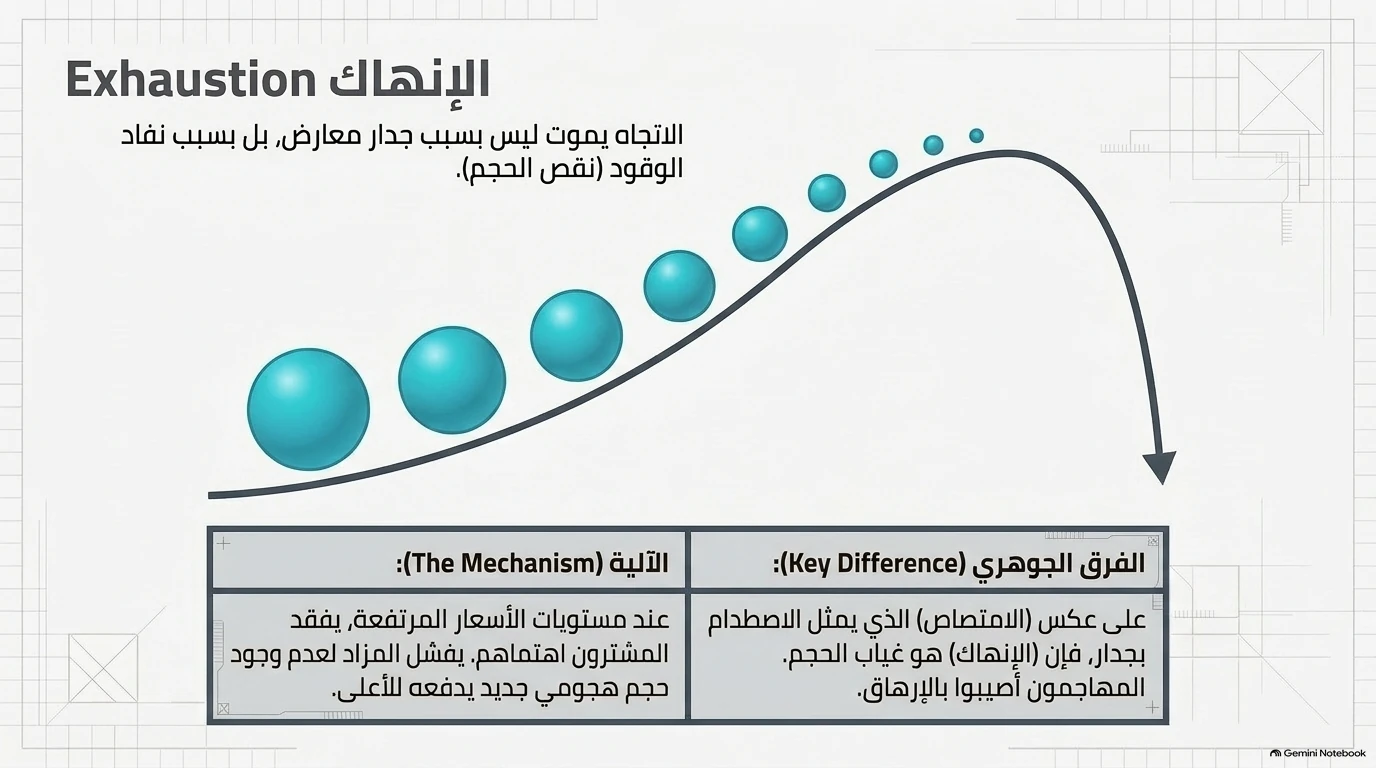
1. The Mechanism of Exhaustion#
A trend cannot continue without continuous aggressive participation. When price reaches extreme levels: * Buyers consider prices too expensive and refuse to submit further market buy orders. * Sellers see no reason to sell aggressively while price is still drifting upward. * The auction stalls not because of a wall, but because of a void of interest.
The Mechanism (الآلية): At elevated price levels, buyers lose interest. The auction fails due to the total absence of new aggressive market volume to push price higher. The Key Difference (الفرق الجوهري): Unlike Absorption — which represents colliding with an impenetrable wall of limit orders under high volume — Exhaustion is the complete absence of volume. The attackers are exhausted.
2. Comparing Absorption vs. Exhaustion#
| Feature | Absorption (Active Defense) | Exhaustion (Depletion) | | :--- | :--- | :--- | | Volume | Exceptionally High | Exceptionally Low / Dwindling | | Delta | Extreme Delta Divergence | Flat or Vanishing Delta | | Footprint Appearance | Large volume clusters at extreme wicks | Low single-digit contracts at extremes | | Reversal Character | Violent, rapid snap | Gradual rounding roll-over | | Cause | Large passive limit orders | Absence of aggressive market buyers |
3. How to Spot Exhaustion on the Footprint#
- Volume Profile Tapering: As price marks consecutive higher highs, each bar prints progressively lower total volume.
- Low Prints at Extremes: The extreme tick of the candle prints very small volume (e.g. 1 or 2 contracts), showing zero continuation interest.
- Delta Compression: Delta per bar collapses from hundreds of contracts down to near zero.
4. Trading Exhaustion#
Because exhaustion lacks the violent momentum of absorption, it requires patience: * Wait for price to round over and break below the prior swing low. * Enter on the subsequent pullback to the breakdown level. * Target the nearest High Volume Node (HVN) where two-way trading previously occurred.
Review the counterpart reversal setup in Order Flow Absorption and study The CZT Setup Framework.
Return to the Order Flow Pillar Guide.