
Markets exist to facilitate trade. Under Auction Market Theory (AMT), price is an advertising mechanism, volume is the measure of acceptance or rejection, and time regulates the opportunity.
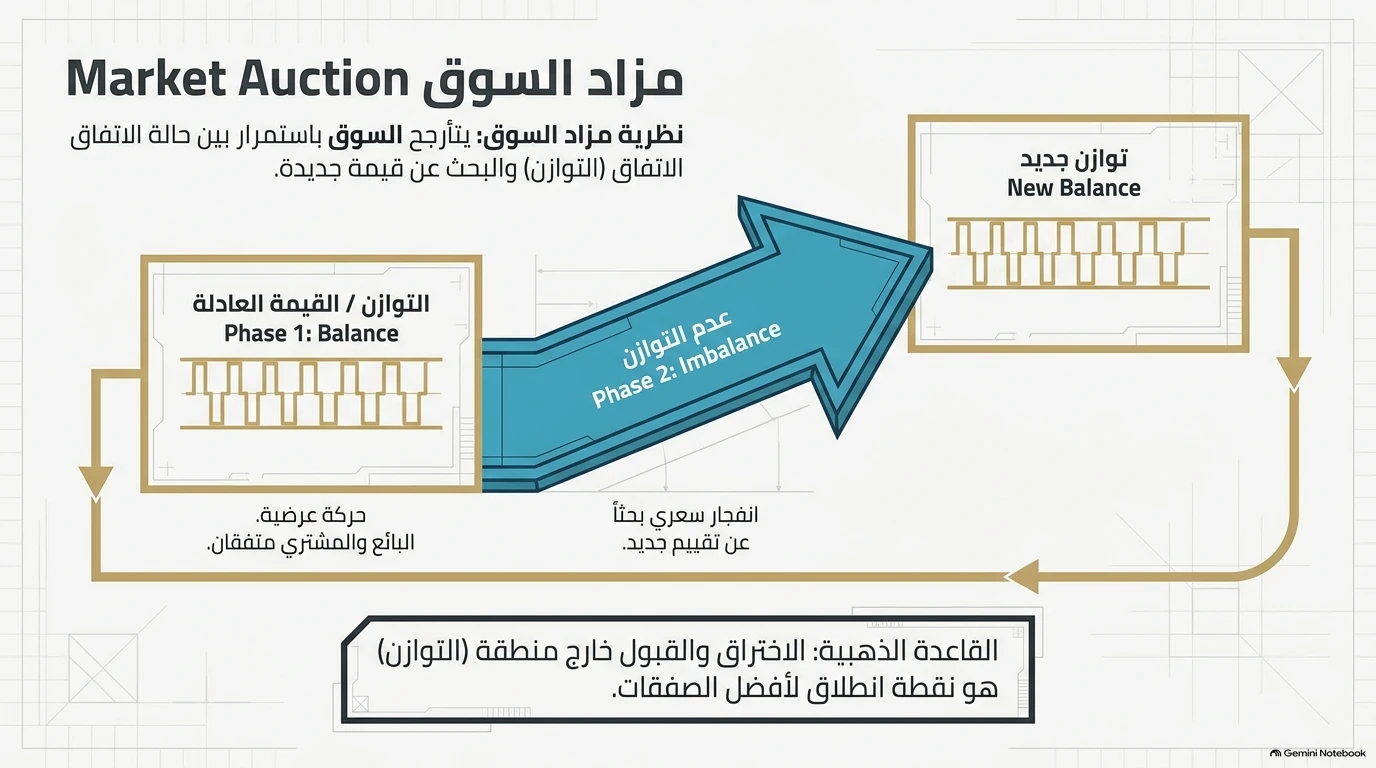
1. The Two Structural Phases of the Market#
Every market continuously oscillates between two distinct phases:
Phase 1: Balance / Fair Value التوازن / القيمة العادلة Market Condition: Sideways bracket or consolidation. Participant Agreement: Buyers and sellers agree on current fair value. Volume Distribution: High two-way trade facilitation. Volume distributes evenly around a bell curve or High Volume Node HVN. Strategy: Trade mean-reversion setups — fading extremes buying at the bottom of the balance and selling at the top.#
Phase 2: Imbalance عدم التوازن Market Condition: Fast, explosive directional trend. Participant Disagreement: One side overwhelms the other; buyers or sellers perceive current prices as unfair. Volume Distribution: Thin, elongated volume profile as price moves rapidly through low volume nodes LVNs searching for new participants. Strategy: Trade directional breakouts and momentum continuation.#
Once the imbalance discovers a level where opposing participants step in with equal size, the auction forms a New Balance (توازن جديد).
2. The Golden Rule of Auction Market Theory#
The Golden Rule: Breakout and acceptance outside the prior balance area is the launching point for the highest-probability trading opportunities.
An attempt to break out of balance is not enough. The market must demonstrate acceptance: * Price must hold outside the balance boundary. * Time must be spent building volume outside the range. * Value must begin migrating higher or lower.
If price probes outside the balance and immediately snaps back inside with heavy absorption, the auction outside value has failed (a Failed Auction), and price will target the opposite extreme of the range.
3. How Order Flow Verifies the Auction#
Order flow tools provide real-time proof of whether an auction is accepted or rejected: * Accepted Breakout: Confirmed by aggressive stacked imbalances, positive delta, and positive Return on Effort (ROE). * Rejected Probe: Characterized by heavy volume absorbed at the boundary with high delta divergence, followed by trapped aggressive traders.
Deepen your auction understanding with our guide on Volume Profile Value Areas and review the Order Flow Entry Confirmation process.
Return to the Order Flow Pillar Guide.