
Entering a trade is only half the battle. How you manage risk and protect open profits determines long-term profitability. Professional order flow trade management moves stop-losses logically behind structural shifts in control, never based on arbitrary tick counts.
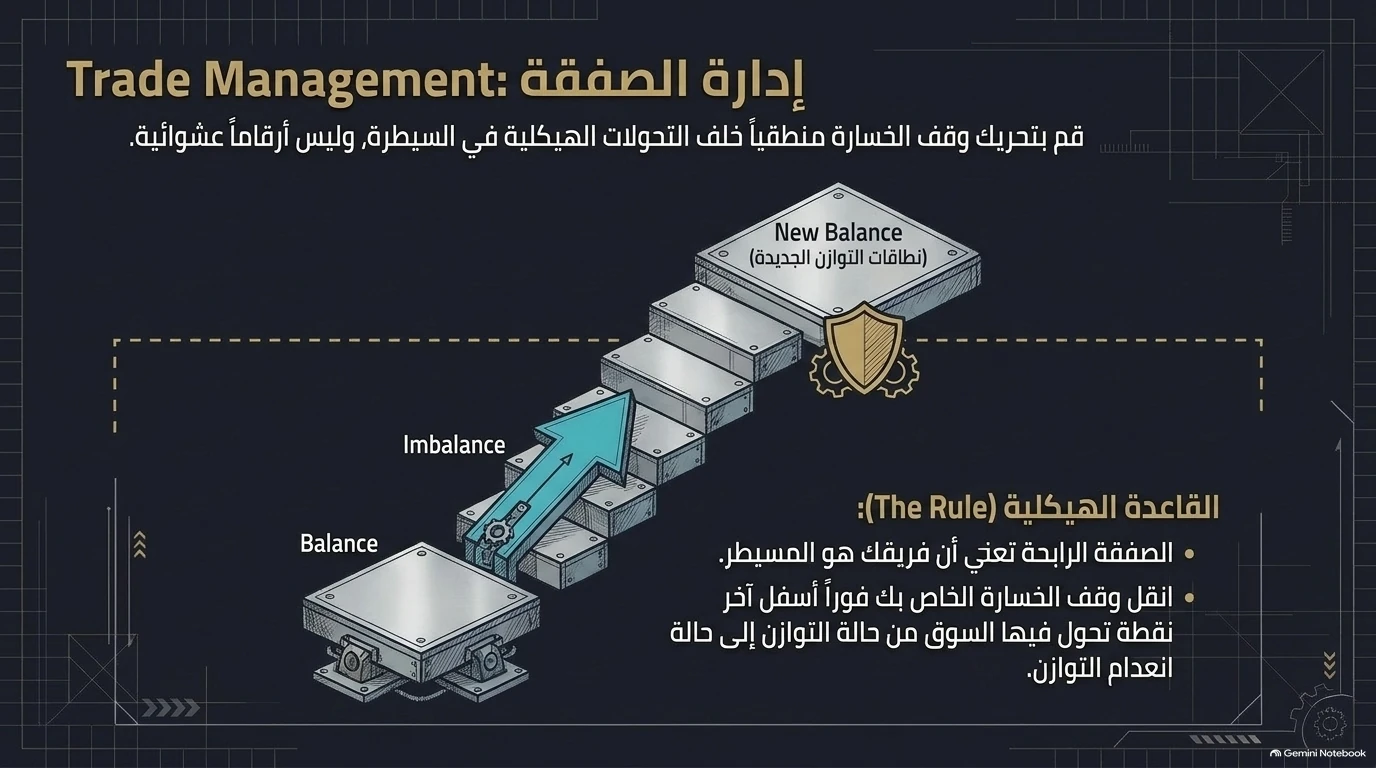
1. The Structural Staircase of the Market#
Markets progress through a repeatable sequence:
Balance (نطاق توازن) → Imbalance (انعدام توازن) → New Balance (توازن جديد)
- Balance: Buyers and sellers consolidate; energy builds.
- Imbalance: Aggressive market orders break out; the market trends directionally.
- New Balance: Price finds new two-way interest and forms a new consolidation bracket.
When you are in a winning position, your side is in control during the Imbalance phase.
2. The Structural Trailing Rule#
The Structural Rule (القاعدة الهيكلية): A winning trade means your team is in control. Move your protective stop-loss immediately below the last point where the market shifted from balance to imbalance.
Do not trail your stop tick-by-tick or use a static trailing algorithm. Instead: * Identify the exact consolidation bracket (Balance) where energy was gathered. * Locate the breakout bar containing stacked aggressive imbalances. * Place your stop just behind the base of that imbalance cluster.
If price returns and violates that imbalance origin, your team has lost control of the auction, and there is no reason to remain in the trade.
3. Profit Targets: Aiming for Liquidity#
Exit orders should be placed where opposing liquidity resides: 1. Target 1: The Point of Control (POC) of the prior balance area. 2. Target 2: Dense resting limit order bands visible on Liquidity Heatmaps. 3. Runner: Trail the remaining position strictly behind the staircase of new balances until an Order Flow Failure Pattern appears.
To track trade metrics, enforce strict drawdown rules, and log execution data, use MA TradeLab. Learn to spot exit signals in Order Flow Failure Patterns.
Return to the Order Flow Pillar Guide.