
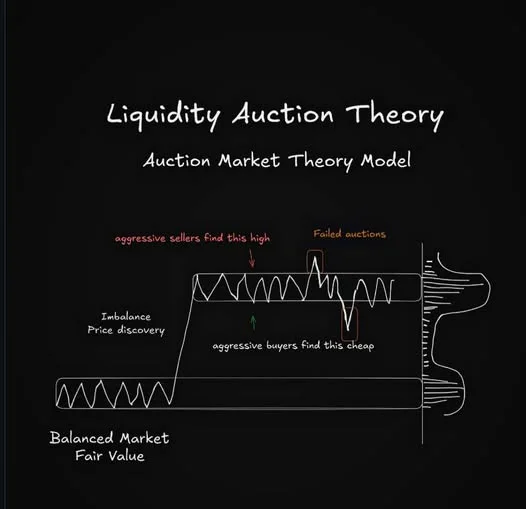
In financial markets, prices do not move randomly; they are the result of a continuous, heated "auction" between buyers and sellers. This auction determines the fair value of an asset at any given moment. But what happens when the market tries to push past certain price levels and fails to convince participants? This is where "Failing Auction Theory" appears.
What is Failing Auction Theory?
Simply put, an auction is a process of "seeking value." When price moves, it is searching for new buyers or sellers. A failed auction occurs when the price moves outside its normal balance range but fails to attract sufficient participation (liquidity) at those new levels, leading to price rejection and a rapid return to previous balance areas.
Successful Auction vs. Failed Auction
| Comparison | Successful Auction | Failed Auction |
|---|---|---|
| Price Movement | Continuous value building in a new direction | False breakout followed by a quick reversal |
| Participation (Liquidity) | Increasing volume supporting the move | Lack of volume at breakout levels |
| Outcome | Acceptance of the new price | Price rejection |
| Continuity | Presence of "follow-through" | Movement cessation and return to range |
How to Spot a Failed Auction?
- Failed Breakout: Price breaks a key support or resistance level but fails to stabilize, returning immediately to the previous range.
- Weak Volume: A price breakout accompanied by weak trading volume is a danger sign; professionals are not supporting the move.
- Rejection Wicks: Long wicks at breakout levels indicate immediate intervention from the opposing side.
- Lack of Continuity: Market moves in a momentary "jump" then stops, indicating supply or demand exhaustion.
Stages of a Failed Auction
- Initial Move: Price exits the balance range.
- Lack of Participation: Buyers or sellers fail to continue the move.
- Rejection: Price finds no acceptance, and the stronger party pushes it back inside.
- Re-Auction: Price returns to explore previous value areas.
- Avoid False Breakouts: If you see a breakout without volume, wait for a "re-test."
- Liquidity Hunts: If price returns quickly after breaking stop-loss levels, it is likely a liquidity sweep.
- Range Trading: When the market rejects price at the high or low, these are the best points for Range Trading strategies.
Comments (0)
Comments are moderated. Your comment will appear after it's approved.
Comments are moderated. Your comment will appear after it's approved.
Loading comments…