
Real trading isn't about predicting where the market is going. It's about reading where the market accepts price and where it rejects it—and acting accordingly.
1. The Auction: The Hidden Mechanism Behind Every Move
Financial markets don't care about "trends," "support," or "resistance" in the traditional sense. These are just human attempts to simplify a complex reality: a continuous, never-ending auction. Every tick is the result of a deal struck between a buyer and a seller at a specific price. Price is not the cause; it is the result.
How the Auction Works:
- Low Price: Buyers rush in.
- High Price: Sellers emerge.
- Balanced Equilibrium: Price stabilizes.
- Imbalance: Price moves rapidly.
The real question isn't "Will it go up or down?" but rather: "Is this price acceptable to the market?"
2. Acceptance vs. Rejection
Markets move because they fail to find acceptance at a certain price level. Acceptance is defined by time and volume; Rejection is defined by speed and a lack of volume.
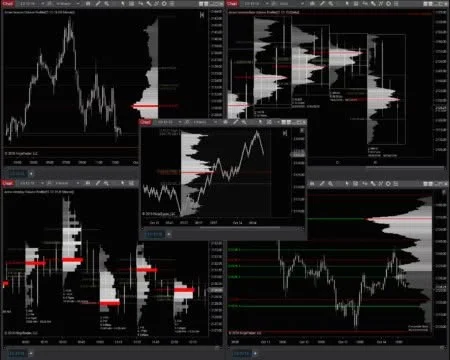
3. Reading the Market with Session Volume Profile
A Session Volume Profile reveals the inner structure of the trading session. It answers the most critical question: "Where did the market actually trade?"
Key Concepts:
- Value Area (VA): The area where the market deemed the price "fair," characterized by heavy volume and time spent.
- Point of Control (POC): The specific price level with the highest volume—the market's primary reference point.
4. Outside the Value: Price Discovery
When price leaves the Value Area, it enters a "Price Discovery" phase. It is no longer in a comfort zone. If the market stays outside and builds volume, a new auction is beginning. If it quickly snaps back, the move was a "failed auction."
5. The Institutional Logic of Execution
Pros don't enter on the "breakout"; they enter on the confirmation of behavior. The most powerful moments occur when the market fails to sustain a move. By combining Volume Profile with Footprint charts and Delta, you move from guessing to responding.
"The market doesn't move because there is an 'opportunity'; it moves because there is a disagreement. Your job is not to predict, but to identify where the agreement lies and where the collapse happens."
Comments (0)
Comments are moderated. Your comment will appear after it's approved.
Comments are moderated. Your comment will appear after it's approved.
Loading comments…