
In modern electronic markets, price does not reverse simply because it touched an indicator line or technical support. True reversals happen through a specific mechanical battle known as Order Flow Absorption.
Understanding how aggressive market participants get trapped by large passive limit orders provides one of the sharpest edges available in intraday futures trading on NQ, ES, and GC.
1. What is Order Flow Absorption?#
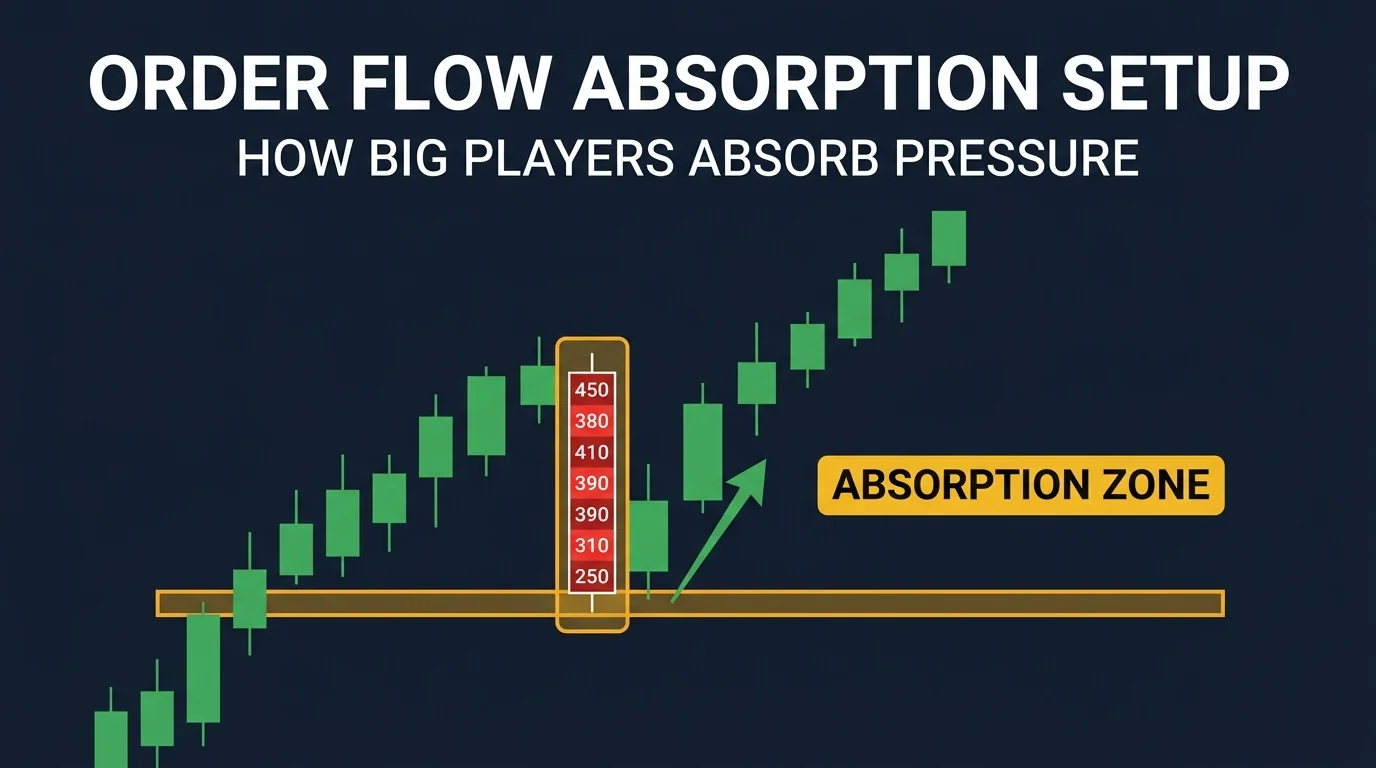
Absorption occurs when heavy market orders (Aggressive Market Orders) are entirely filled by large resting limit orders (Passive Limit Orders) at a specific price level without allowing price to move further in the direction of the aggressive flow.
- Buying Absorption (At Resistance): Aggressive buyers hit the Ask with thousands of market contracts, but a large institutional seller holds a massive limit order at that price. The price cannot tick higher despite massive positive delta. Once buyers tire out, price drops rapidly.
- Selling Absorption (At Support): Aggressive sellers dump market orders into the Bid, but institutional buyers absorb every sell contract with passive limit bids. Once selling ceases, price rallies sharply.
2. Reading Absorption on a Footprint Chart#
On an order flow footprint chart, absorption leaves a distinct footprint signature:
- Volume Clustering at Extremes: A large surge in traded volume concentrated on the extreme high or low of the candle.
- Extreme Delta Divergence: Heavy positive delta printed at a candle high with a long upper wick, or heavy negative delta at a candle low with a long lower wick.
- Trapped Traders Confirmation: The subsequent candle prints an immediate reversal and breaks the low of the absorption cluster, trapping market participants on the wrong side.
3. Absorption vs. Exhaustion#
It is vital to distinguish between two completely different reversal mechanisms:
- Absorption (Active Defense): High volume + heavy market aggression failing to move price + passive institutional limit orders present.
- Exhaustion (Lack of Interest): Low volume + absence of market orders + price rolling over simply because nobody is willing to bid or offer at that level.
4. Execution Framework & Trade Setup#
When trading Nasdaq (NQ) or S&P 500 (ES) futures:
- Location: Wait for price to reach a major structural level, such as a Value Area High (VAH), prior day high, or Untested POC.
- Identification: Spot a Footprint candle showing heavy volume absorption (e.g. +800 delta absorbed at the highs without continuation).
- Entry: Enter Short on the close of the reversal confirmation candle.
- Stop-Loss: Place your protective stop strictly 2–4 ticks above the absorption wick high.
- Take-Profit: Target the nearest high-volume node (HVN) or the session POC.
To master how volume distributions build these critical reversal levels, study our Volume Profile Mastery Guide, explore the Order Flow Evolution, or view the complete A+ Trade Setup Blueprint. To journal your execution data and manage prop firm drawdown rules in real time, explore MA TradeLab.
Comments (0)
Comments are moderated. Your comment will appear after it's approved.
Comments are moderated. Your comment will appear after it's approved.
Loading comments…