
The Problem With Trading Support and Resistance Alone
Support and resistance levels are among the most universally understood concepts in technical trading. Price approaches a prior high — traders watch for resistance. Price drops to a prior low — traders watch for support. The logic is sound: these levels represent prices where significant buying or selling occurred in the past.
The problem is validation. When price reaches a support zone, you have historical evidence that the level mattered before. You have no direct evidence that it matters right now, in this moment, with today's market participants. A level that held four times in the past might simply fail on the fifth test. Nothing in standard technical analysis tells you which scenario you're facing before the outcome is clear.
Order Flow data changes this. By observing what actually happens at a support or resistance level in real time — specifically whether a large institutional participant is stepping in with significant size — you gain direct, observable evidence of whether the level is being actively defended or abandoned. This is the core value of big player confirmation.
What Is Big Player Confirmation?
Big player confirmation is the presence of a single, unusually large order at a key support or resistance zone at the moment price reaches that level. It transforms historical S/R analysis from a pattern-based exercise into a live-evidence-based one.
The confirmation works like this:
- You've identified a significant support or resistance level through standard technical analysis (prior swing highs/lows, Volume Profile levels, vwap-pullback">anchored VWAP, etc.)
- Price approaches that level
- Your Order Flow trade filter shows a single large order appearing at or very near that level
- This large order tells you a significant participant has just committed meaningful capital to that exact price
The presence of institutional size at a level you've already identified as significant creates a convergence of evidence. The historical significance of the level plus the real-time institutional activity equals a higher-conviction trade than either piece of evidence provides alone.
The Trade Filter: Turning Noise Into Signal
Raw Order Flow data is an undifferentiated stream of every transaction in the market. A single session in a liquid market generates thousands of individual trades, the vast majority from retail participants, small algorithms, and market makers managing their books. All of this activity creates noise that obscures the institutional-scale orders you actually want to see.
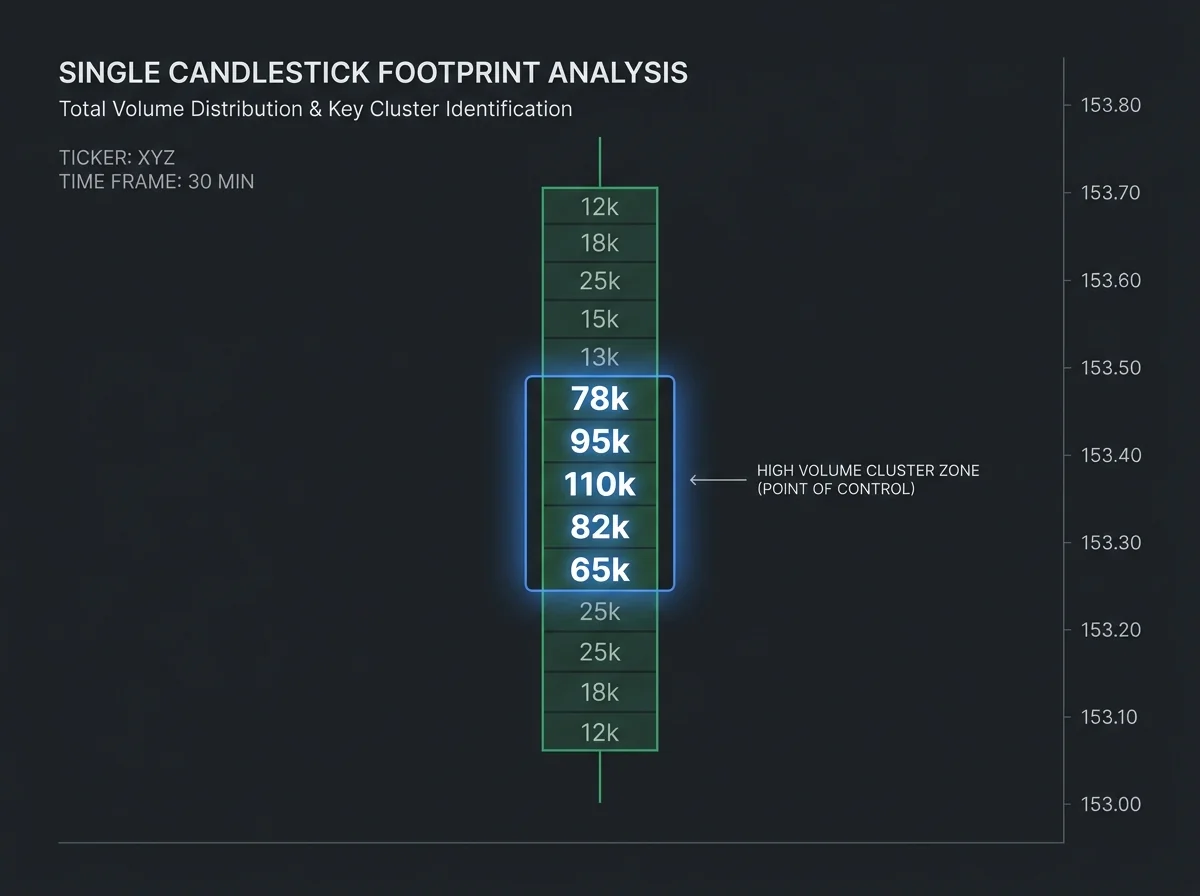
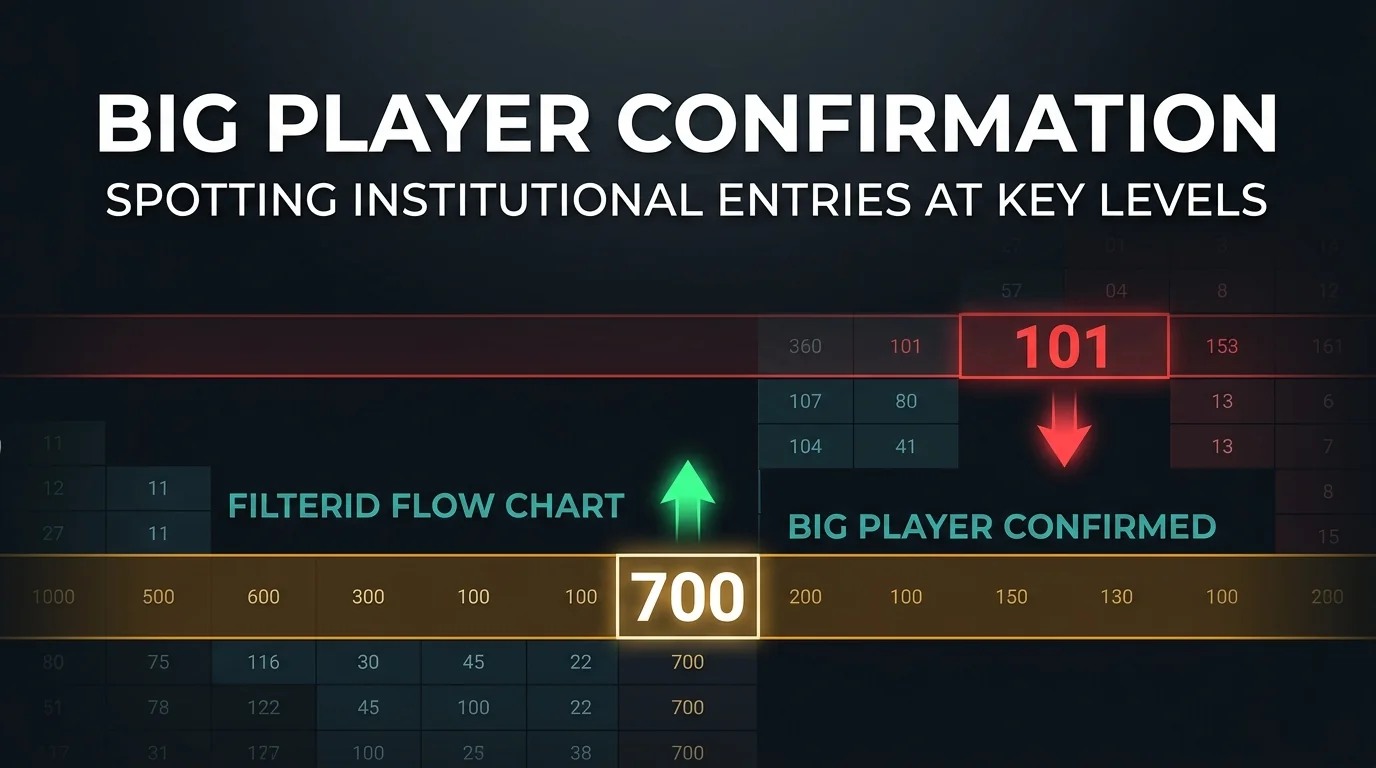
The Order Flow trade filter solves this by applying a minimum trade size threshold. Any transaction below your chosen threshold disappears from the chart. Only orders exceeding the threshold remain visible. The practical result: when your filtered chart lights up, it means something large just happened — and large means institutional.
Setting this threshold is a calibration process (detailed in the companion article on the basic Order Flow trade filter). For the purpose of big player confirmation, the important principle is that your threshold should be set at a level where the orders that remain visible are clearly anomalous — significantly larger than the typical order flow in that market.
What Counts as a True Big Order
A genuine big player confirmation order has specific characteristics that distinguish it from noise:
Single execution: The order is one transaction, not multiple smaller orders arriving sequentially. A single 700-contract order appearing instantaneously is categorically different from 700 individual 1-contract orders filling over several minutes. Only the single large order indicates a deliberate, one-time institutional decision.
Timing alignment: The order appears at the support or resistance zone — at the moment price tests that level, not at a random point during the session. Timing is critical. A large order in the middle of a trend, away from any S/R, carries different meaning than one that appears exactly as price reaches a level you've been monitoring.
Size relative to surrounding activity: Even if your filter is calibrated correctly, some orders will be more anomalous than others. A 700-contract order when your filter is set to 50 lots is a dramatic outlier. A 60-contract order on the same filter is only modestly above threshold. The more a big order exceeds your filter threshold, the more attention it deserves.
Absence of iceberg structure: Be aware that some institutional orders are "icebergs" — large orders broken into many small executions to disguise their true size. Your filter won't catch icebergs, since each individual fill is small. What you're looking for is single, undisguised large orders — those that appear in one block on your footprint chart.
Confirming Longs at Support: Bid-Side Big Orders
When price approaches a support zone and your trade filter shows a large order, the side of the order (bid vs ask) adds an additional layer of directional clarity.
At a support zone in a long confirmation scenario:
- Large order on the bid side: This is a limit buy order that was filled. The institution placed a buy limit at the support level, waited for price to reach it, and the order filled as price came down to them. This is the clearest form of big player confirmation for a long trade — the institution is demonstrably buying at this specific price level.
- Large order on the ask side: This could mean the institution hit the offer to establish a long position aggressively. Less common for patient institutional accumulation, but still a bullish signal if price immediately holds and bounces.
Practical scenario: Price has been declining and approaches a prior swing low at 1.0840 (a support level you marked in advance). As price touches 1.0840, your filter shows a single order of 700 contracts on the bid. This is live evidence that a large buyer has just committed to this price. Your prior analysis said this level matters. The order flow says someone large is acting on that assessment right now. Combined, this is your entry signal for a long position.
Confirming Shorts at Resistance: Ask-Side Big Orders
The mirror image applies at resistance zones:
- Large order on the ask side: A sell limit order executed as price reached the resistance level. The institution placed a sell limit at resistance, and price rising to that level triggered their fill. This is direct evidence of institutional selling pressure at a level you've already identified as significant.
- Large order on the bid side at resistance: Less typical, but can occur when an institution sells aggressively using market orders (hitting the bid) at a level they want to exit quickly.
Practical scenario: Price rallies toward a well-defined resistance at a prior swing high. As price reaches the resistance zone, your filter shows a single order of 101 contracts on the ask. This tells you a meaningful seller just executed at this resistance level. The combination of the historical resistance and the live institutional selling creates a high-conviction short entry.
| Zone | Big Order Side | Interpretation | Trade Direction |
|---|---|---|---|
| Support | Bid | Institution buying at support | Long |
| Support | Ask | Aggressive institution buying | Long (with less certainty) |
| Resistance | Ask | Institution selling at resistance | Short |
| Resistance | Bid | Aggressive institution selling | Short (with less certainty) |
Multiple Large Orders at the Same Zone
Sometimes big player confirmation arrives not as a single massive order, but as two or more large orders appearing close together at the same zone:
- A 600-contract order followed by a 400-contract order, both at the ask at resistance
- Two 300-contract orders within the same candle at support
This pattern can arise from multiple institutions acting at the same level simultaneously, or from a single institution splitting a very large order into multiple large tranches to manage market impact while still acting quickly.
Either way, the reading is the same as a single very large order: significant participants are active at this level with defined directional intent. Multiple large orders at the same zone, on the same side of the market, is actually a stronger confirmation than a single large order because it suggests either coordinated activity or genuinely exceptional institutional interest.
Repeated Order Sizes: Reading Position Exits
One of the more sophisticated applications of the trade filter involves tracking repeated identical order sizes across different points in a session or across consecutive sessions.
Consider this sequence:
- You entered a short from resistance after seeing two orders — a 600-contract and a 400-contract — appear at the ask
- Your short trade plays out successfully and price declines
- Much later, at a lower support zone, you notice the exact same order sizes appear again: a 400-contract order and a 600-contract order in close succession
This is not coincidence. The probability is high that the same institution that entered their short at resistance is now exiting that position at the lower support zone. They entered with two sell orders of 600 and 400 contracts. They're exiting with corresponding buy orders of the same sizes.
Why this matters:
- It tells you the institution considers the current price a reasonable exit for their short
- It suggests the support zone is significant enough for the same large player who drove the move down to use as their profit-taking target
- This can either serve as a long entry signal (institutional buying near support) or as a short exit signal for your own position, confirming you've reached a natural target
This use of repeated order sizes gives you a secondary layer of information: not just where institutions enter, but where they take profits. Tracking this pattern across multiple trades in the same market builds a picture of institutional behavior that's difficult to obtain from any other data source.
Integrating Big Player Confirmation Into Your Trade Process
Big player confirmation is most powerful when used as a filter or trigger within an existing trade process, not as a standalone reason to enter:
Step 1 — Identify the zone first: Using your preferred technical analysis method, mark support and resistance levels you consider significant before price arrives. Volume Profile nodes, prior swing highs/lows, anchored VWAP levels, and VWAP resistance/support all qualify.
Step 2 — Wait for price to reach the zone: Don't trade away from the zone. The confirmation only carries weight when it appears exactly at the level you identified. A large order in the middle of a range has no confirmation value.
Step 3 — Watch for a filtered order at the zone: When price enters the S/R zone, monitor your filtered Order Flow chart. You're waiting for a single large order — clearly above your threshold — to appear within the zone boundaries.
Step 4 — Note the bid/ask side: Confirm the order appeared on the appropriate side (bid at support for longs, ask at resistance for shorts) for maximum directional certainty. An order on the "wrong" side is still informative but reduces conviction.
Step 5 — Enter and place your stop: Enter in the direction suggested by the large order. Place your stop loss just beyond the zone — below support for longs, above resistance for shorts. If the institutional level breaks, the confirmation is invalidated.
Common Mistakes to Avoid
Trading without a pre-identified zone. Big orders in empty space carry no confirmation value. The power of this approach comes from the convergence of historical S/R significance and real-time institutional presence. Without the pre-identified zone, you're just reacting to large orders without structural context.
Confusing iceberg orders with single large orders. Icebergs create a pattern of many same-sized small orders, not one large single transaction. If you see 20 consecutive 10-contract orders, that's potentially an iceberg — not the same as one 200-contract order.
Entering before the order appears. The confirmation has to actually show up. Many traders anticipate the large order and enter early, then find no confirmation materializes. Wait for the order to appear before committing to the trade.
Misreading the bid/ask side. In forex especially, the bid/ask distinction is less reliable than in futures due to data reporting differences. When trading forex with tick volume, focus primarily on the size of the order and what price does immediately after, rather than over-emphasizing which side the order appeared on.
Abandoning the method after a failed confirmation. Large orders at S/R will sometimes not produce the expected reaction. Occasionally, the institution that placed the order gets stopped out, or the zone simply doesn't hold. This is normal. The confirmation increases probability — it doesn't guarantee outcomes. Evaluate the method over a sample of 20+ occurrences, not individual trades.
Final Thoughts
Big player confirmation bridges the gap between static technical analysis and dynamic market observation. Support and resistance levels are valuable historical anchors. But history doesn't guarantee the present — and that's exactly what Order Flow data fills in. A large single order at a key zone is the market telling you, in real time, that someone with serious capital agrees this level matters right now.
The trade filter makes this accessible. Without filtering, the signal is buried. With it, the large orders jump out clearly against the background of retail noise. Once you've calibrated your filter and practiced spotting these orders on historical charts, the skill becomes intuitive — you stop guessing at support and resistance and start watching for actual evidence.
Add the repeated order size pattern for additional depth, and you have a framework that not only tells you where to enter, but gives you clues about where large players are likely to exit. That kind of insight — traded with proper risk management and consistent execution — represents a meaningful edge over pure price-based analysis.
FAQ
What is big player confirmation in Order Flow trading?
It's the appearance of a single, unusually large order at a key support or resistance zone, providing real-time evidence that an institutional participant is actively trading at that level rather than relying solely on historical S/R behavior.
Does the bid or ask side of the big order matter?
At support zones, bid-side orders provide the clearest confirmation for longs (institutional buying via limit orders). At resistance, ask-side orders provide the clearest confirmation for shorts. However, the most important factors are the order size and what price does immediately after.
What's the difference between a single big order and an iceberg order?
A single big order appears as one large transaction in a single row of your footprint chart. An iceberg order is a large order disguised as many smaller transactions of identical size. The trade filter won't reveal icebergs — it's specifically designed to highlight single, undivided large orders.
How do repeated order sizes signal position exits?
If you see identical large order sizes (e.g., 600 and 400 contracts) appearing first at a resistance zone (entries) and later at a lower support zone (exits), the same institution is likely exiting the position they opened at resistance. This provides insight into institutional profit-taking levels.
Can I use this approach in forex?
Yes, with limitations. Forex lacks the precise bid/ask data available in futures, so the directional reading from bid vs ask side is less reliable. Focus on the size of the order and price behavior after it appears. The approach works best in futures markets.
How often do large orders appear at key zones?
It varies by market and session. On liquid futures markets during active hours, multiple filtered orders may appear per session. Not every S/R zone will receive confirmation on every test — patience is required. When the zone is important AND the confirmation appears, the trade has its strongest foundation.
Disclaimer: Educational content for traders. Not financial advice, not a signal service, and no outcome is guaranteed. Test every rule yourself before risking capital.
Comments (0)
Comments are moderated. Your comment will appear after it's approved.
Comments are moderated. Your comment will appear after it's approved.
Loading comments…