
Why a Fixed VWAP Anchor Point Matters
The standard daily VWAP resets at the start of every trading session. This makes it useful for intraday context — it shows the fair price for today's session — but it loses all connection to market events that occurred outside the current day. A major swing low that happened two days ago, for example, carries no weight on the standard daily VWAP. Its anchor point is always midnight, regardless of whether anything significant happened there.
Anchored VWAP solves this by allowing you to choose the specific candle the calculation starts from. Instead of a session reset, you pick a structural event — a swing high or swing low — and the VWAP calculates from that precise moment forward, indefinitely. This creates a dynamic fair value reference that is directly tied to a specific market structure event, rather than an arbitrary time reset.
When you anchor VWAP to a significant swing point, you create a line that updates continuously as new candles form, reflecting the volume-weighted average price from that swing's origin. This line often acts as dynamic support or resistance during subsequent pullbacks — making it one of the most practically useful tools for trend-following entries.
What Is the Swing Point VWAP Strategy?
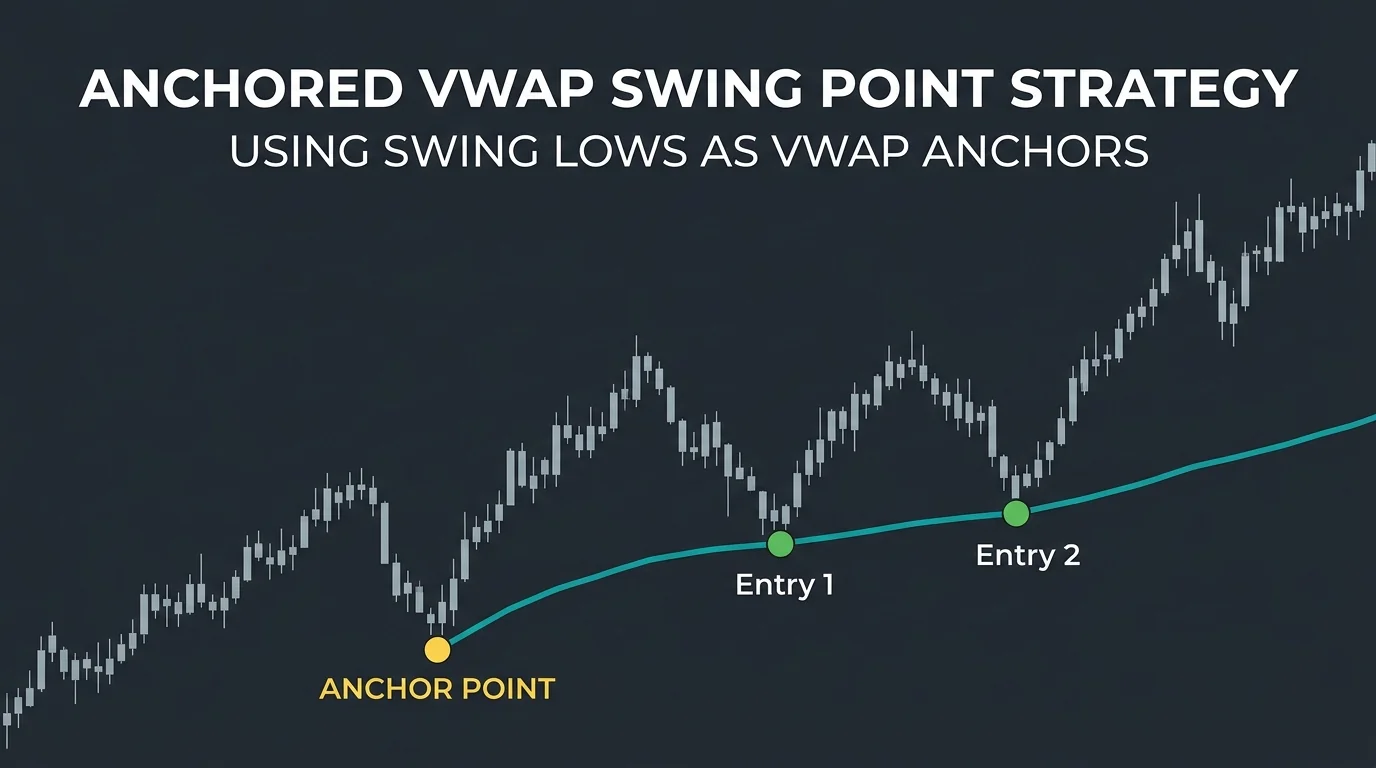
The swing point VWAP strategy is a pullback entry method for trending markets. Its core logic:
- Identify a significant swing point (high or low) that marks the beginning of a trend move
- Anchor your VWAP to that swing point
- Trade the subsequent pullbacks back to the VWAP line in the direction of the trend
The strategy is trend-following in nature — you are not trying to catch reversals or identify tops and bottoms. You are finding high-quality entries within an established trend, at a price level that carries structural meaning as a fair value reference from the trend's origin.
This approach differs from the Volume Profile rotation strategy (which anchors VWAP to the end of a consolidation phase) in that the swing point anchor is drawn from a clear price extreme — a visible high or low — rather than from within a consolidation zone. Both methods produce anchored VWAPs, but they represent different market structure events.
Understanding Swing Highs and Swing Lows
Before applying the strategy, clarity on what qualifies as a swing high or swing low is essential.
Swing low: A candle whose low is lower than the lows of the candles immediately before and after it. Not every local dip qualifies — you want a swing low that is visually significant: one that attracted buying and produced at least a meaningful bounce before the next leg of the trend.
Swing high: A candle whose high is higher than the highs of the candles immediately before and after it. Again, significance matters — not a minor peak in a choppy range, but a high that attracted selling and produced a meaningful pullback.
Significance criteria:
- The swing point produced a reaction of at least 50% of the prior move's range before the trend resumed
- The swing point is the most extreme high or low in the visible context of the chart
- The swing point is the starting location of a momentum move — it's where the market clearly accelerated in the trend direction
Minor, unremarkable highs and lows produce unremarkable VWAPs. Significant, structure-defining swing points produce VWAPs that the market consistently returns to.
Choosing the Right Swing Point to Anchor From
Not every swing point produces an equally useful VWAP. Three factors determine anchor quality:
1. The significance of the swing itself
The swing point should be a clearly identifiable structural extreme — one that would be obvious to any experienced trader looking at the chart without any indicators. If you have to hunt for it or explain why it matters, it probably doesn't qualify. The best swing points are unambiguous: clear lows in uptrends, clear highs in downtrends, at locations where the market demonstrably accelerated.
2. The trend context following the swing
After a strong swing low in an uptrend, price should have moved meaningfully higher before any pullback. After a swing high in a downtrend, price should have moved meaningfully lower. The strength of the move away from the swing confirms that the swing point represents genuine directional conviction, not a random fluctuation.
3. Recency and continued relevance
The swing point you anchor from should be recent enough to still represent the current trend phase. A swing low from six months ago may have been superseded by more recent market events. Use the most recent significant swing that best captures the current trend's origin.
How the Anchored VWAP Becomes Dynamic Support or Resistance
Unlike a fixed horizontal support or resistance line, the anchored VWAP changes its price level over time. It slopes upward in uptrends (because higher prices are being traded) and downward in downtrends (because lower prices are being traded). This dynamic nature is what makes it a powerful reference rather than a static level.
In an uptrend:
- The VWAP anchored to a swing low slopes gradually upward
- During pullbacks, price declines toward the rising VWAP line
- The VWAP level represents the volume-weighted fair price from the swing low's origin — a price at which significant buying and selling has balanced since the trend began
- Buying at the VWAP is equivalent to buying at "fair value" from the trend's perspective
In a downtrend:
- The VWAP anchored to a swing high slopes gradually downward
- During pullbacks (upward retracements), price rises toward the declining VWAP line
- Selling at the VWAP is equivalent to selling at fair value from the trend's perspective
The VWAP level at any point in time is the mathematically derived average price (weighted by volume) since the anchor point. When the trend's participants broadly bought above this level (uptrend) or sold below it (downtrend), the VWAP represents the collective equilibrium price of the trend. Returning to equilibrium is a natural market tendency.
Step-by-Step: Executing the Pullback Trade
Step 1: Identify the Trend
The strategy requires a clear, established trend. Define "trend" objectively: higher swing highs and higher swing lows (uptrend), or lower swing highs and lower swing lows (downtrend). The stronger and more consistent the trend, the more reliable the VWAP pullback entries.
Step 2: Identify the Most Recent Significant Swing Point
Locate the most recent significant swing low (for uptrends) or swing high (for downtrends) that best represents where the current trend phase began. This is your anchor candidate.
Step 3: Place the VWAP Anchor
Anchor your VWAP to the candle representing your chosen swing point. The VWAP line will extend from that candle to the present, updating in real time.
Step 4: Wait for a Meaningful Pullback
After the anchor is placed, wait for price to begin pulling back toward the VWAP line. A "meaningful" pullback is one that covers at least 30-50% of the prior trend leg — enough to indicate a genuine retracement rather than minor noise.
Step 5: Monitor Price as It Approaches the VWAP
When price is within 5-10 pips (or equivalent) of the VWAP, shift to a lower time frame to monitor the interaction. You want to see:
- Price slowing as it approaches the VWAP
- Candle wicks forming toward the VWAP line and reversing
- A bullish candle structure forming at the VWAP level (for long entries in uptrends)
Step 6: Enter in the Direction of the Trend
When price touches or comes very close to the VWAP and shows reversal characteristics:
- Uptrend: Enter long. Stop loss below the VWAP with a buffer.
- Downtrend: Enter short. Stop loss above the VWAP with a buffer.
Step 7: Target the Next Structural High or Low
Set your take profit at the next significant swing high (for longs) or swing low (for shorts) — or use the most recent swing extreme as your target.
| Trend | Anchor Point | Trade Direction | Entry Location | Stop Loss |
|---|---|---|---|---|
| Uptrend | Swing Low | Long | Price touches VWAP from above | Below VWAP |
| Downtrend | Swing High | Short | Price touches VWAP from below | Above VWAP |
When to Update Your Anchor to a New Swing Point
The VWAP anchored to a specific swing point has a natural lifespan. It remains useful as long as:
- The trend phase it represents is still active
- Price continues to respect the VWAP line on pullbacks
It should be replaced when:
A new, more significant swing point forms: As trends develop, new swings occur. A strong new swing low in an uptrend may be a better anchor than the original one, because it better captures the current trend phase's momentum.
Price decisively breaks the VWAP: If price closes convincingly through the VWAP with momentum, the line's support/resistance function is compromised. Consider whether the trend has changed, and if a new anchor point (or a reversal setup) is appropriate.
The anchor is too far in the past: Very old swing points become less relevant as market conditions evolve. If your anchor is from a swing 30+ sessions ago and the market has gone through multiple phases since then, fresher structural analysis may be more applicable.
Multiple Anchors: Using More Than One VWAP at Once
Advanced practitioners sometimes maintain two or three anchored VWAPs simultaneously, each from different swing points at different structural levels. This creates a layered reference system:
- Short-term anchor: From the most recent minor swing point — relevant for intraday context
- Medium-term anchor: From the most recent major swing point — relevant for the current trend phase
- Long-term anchor: From a major macro swing point — relevant for the broader trend context
When multiple VWAP lines converge at the same price level simultaneously, that convergence zone carries exceptional weight. Price approaching a zone where a short-term, medium-term, and long-term anchored VWAP all align is a high-priority pullback entry candidate.
This multi-anchor approach requires careful chart management to avoid visual clutter, but the additional context it provides can significantly improve entry precision.
Markets and Time Frames
The swing point VWAP strategy is effective across markets wherever reliable volume data is available:
Futures markets: Best application. Precise volume data, clear institutional participation, and clean swing structures make this strategy exceptionally well-suited to futures.
Equity markets: Works well. Swing points in individual stocks and indices tend to be clean and visually identifiable. Volume data is readily available.
Forex: Works with tick volume as a proxy. Swing points in major currency pairs are clearly defined. Less precision than futures but still directionally useful.
Time frames: Most effective on 15-minute, 30-minute, and 1-hour charts. Higher time frames produce fewer but more significant setups. Lower time frames produce more frequent but noisier signals.
Common Mistakes to Avoid
Anchoring to minor, insignificant swing points. The quality of the VWAP output depends entirely on the quality of the anchor. Anchoring to a small, unremarkable swing produces a VWAP line that carries little market-structure significance.
Expecting perfect touch of the VWAP. Price will often come close to the VWAP without touching it exactly before reversing. Don't wait for a precise pip-perfect touch if price is clearly approaching and showing reversal signals near the VWAP.
Trading against the trend direction. The swing point VWAP is a trend-following tool. Using it to enter counter-trend (e.g., shorting at the VWAP when the trend is bullish) removes its primary advantage.
Holding on to an outdated anchor. When a more significant swing point has formed, or when the trend has clearly changed, update or remove the old VWAP anchor rather than forcing relevance onto a stale reference.
Not having a clear stop loss plan. The VWAP line defines your risk reference. Your stop goes beyond the VWAP, not vaguely "somewhere below it." Define it precisely before entry.
Final Thoughts
The anchored VWAP swing point strategy is one of the most elegant applications of VWAP technology in trend-following trading. By connecting the VWAP to a specific, meaningful market event — rather than an arbitrary daily reset — it creates a reference line that actually reflects where the market's participants have been trading since the trend began.
Pullbacks to the swing-anchored VWAP are natural retracements to equilibrium. They offer trend-following traders the best of both worlds: entry in the direction of the established trend, at a price level that carries genuine mathematical significance. The stop is clearly defined (beyond the VWAP), the direction is clear (the trend), and the patience requirement is manageable (waiting for the pullback to reach the VWAP).
Practice is the key variable. Identifying significant swing points, placing accurate anchors, and reading the VWAP interaction on lower time frames all improve with deliberate repetition on historical charts before live application. Build that repetition, and the swing point VWAP pullback becomes one of the most consistent tools in your trading framework.
FAQ
What is the anchored VWAP swing point strategy?
A trend-following pullback strategy that anchors VWAP to a significant swing high or low, then trades pullbacks back to the VWAP line in the direction of the established trend.
How do I choose which swing point to anchor to?
Choose the most recent significant swing point that best represents where the current trend phase began. It should be visually obvious, followed by a strong directional move, and recent enough to represent current market conditions.
How does the swing-anchored VWAP act as dynamic support/resistance?
The VWAP represents the volume-weighted fair price since the anchor point. In uptrends, it rises with the trend and provides natural support on pullbacks. In downtrends, it falls with the trend and provides natural resistance on pullbacks (upward retracements).
When should I update the anchor to a new swing point?
When a new, more significant swing point forms, when price decisively breaks through the VWAP, or when the current anchor is from an outdated phase of the market that no longer represents current conditions.
Does this strategy work in forex?
Yes, using tick volume as a proxy for real volume. The VWAP calculation is slightly less precise than in futures, but swing points in major forex pairs are clearly identifiable and the strategy's logic applies.
Can I use multiple anchored VWAPs simultaneously?
Yes. Multiple anchors from different swing points at different time horizons create a layered reference system. When multiple VWAP lines converge at the same price zone, that zone carries heightened significance for pullback entries.
Disclaimer: Educational content for traders. Not financial advice, not a signal service, and no outcome is guaranteed. Test every rule yourself before risking capital.
Comments (0)
Comments are moderated. Your comment will appear after it's approved.
Comments are moderated. Your comment will appear after it's approved.
Loading comments…