
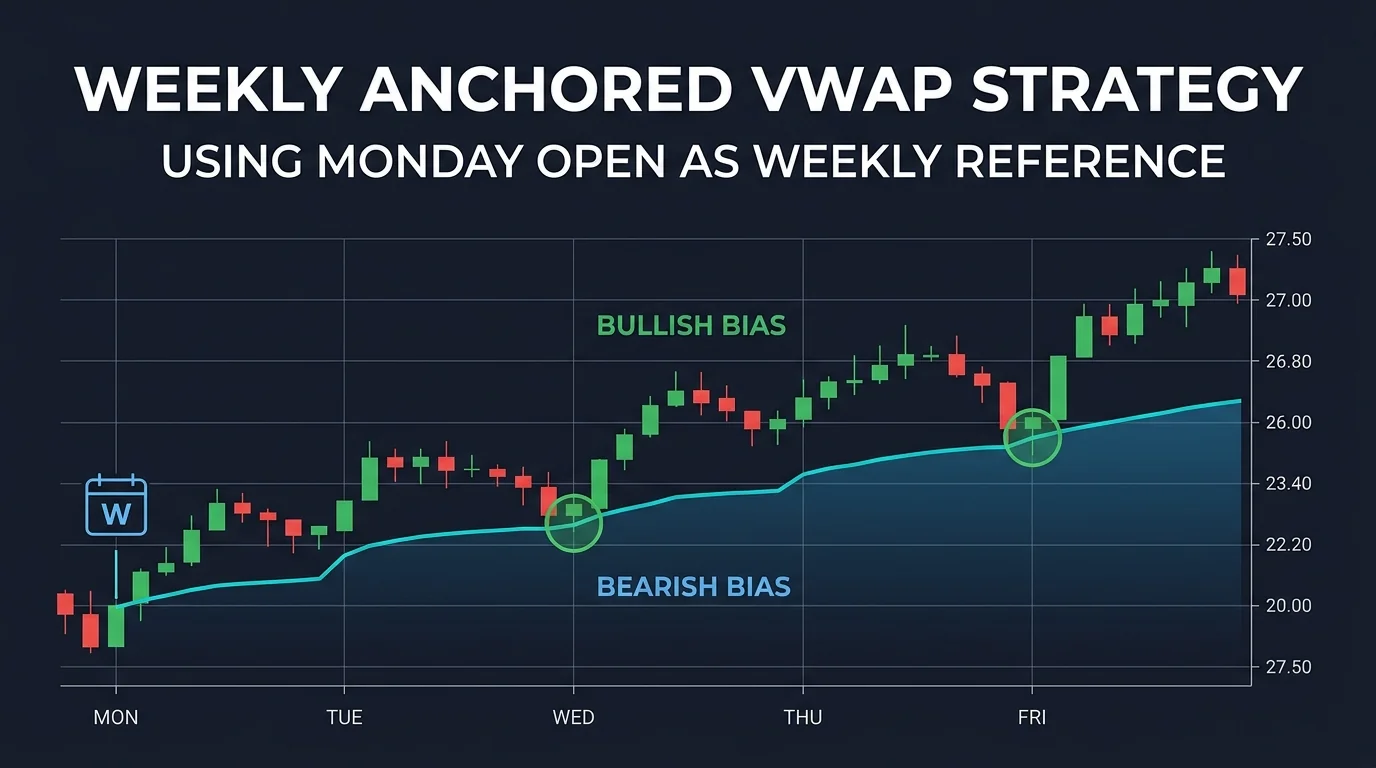
The Limitation of the Standard Daily VWAP
The traditional daily VWAP is one of trading's most widely followed indicators. It calculates the volume-weighted average price for a single trading session, resetting at midnight every day. Traders use it to gauge whether price is trading above or below its intraday fair value, and institutions use it as a benchmark for execution quality.
But for intraday traders who think in terms of weeks rather than just individual days, the daily VWAP has an inherent weakness: it resets every 24 hours regardless of what happened the day before. Monday's dominant theme, the week's developing structure, the narrative that's been building since Sunday night's open — none of this carries forward into Tuesday's VWAP calculation. Every day starts fresh, disconnected from the broader weekly context.
This is where the weekly anchored VWAP offers a meaningful upgrade. By anchoring the VWAP to the Monday open (or Sunday open for 24-hour markets) and allowing it to run through the entire trading week, you create a consistent reference point that captures the full week's activity. Instead of a fresh slate every day, you have a single, continuously updating fair value line for the entire weekly period.
Why Anchor VWAP to the Monday Open?
The choice of the Monday open as the weekly anchor point is deliberate and logical:
It represents a fresh weekly cycle. Most institutional participants and major market participants reassess their positioning at the start of each week. Macroeconomic events, risk appetite shifts, positioning changes — these tend to cluster around weekly transitions. Monday's opening is where the week's directional bias begins to form.
It creates consistency. By always anchoring to the same relative point in the weekly cycle — the start of Monday — you create a comparable reference across weeks. This makes it possible to build expectations about how price typically behaves relative to its weekly VWAP across different market conditions.
It's where institutional activity often concentrates. Monday's opening hours tend to see significant institutional order flow as participants execute the strategies they've formulated over the weekend. This activity often establishes the week's directional lean, making the Monday open a meaningful structural reference point.
For markets that trade 24 hours (most forex and futures markets), the anchor can be placed at Sunday's open or at Monday's official market open — whichever represents the start of the institutional week for that instrument.
The Weekly VWAP as a Directional Bias Tool
The single most powerful application of the weekly anchored VWAP is as a bias filter — a simple tool that tells you whether the week's majority of participants (weighted by volume) are positioned above or below the current price.
Price above the weekly VWAP:
The volume-weighted average price for the week is below the current price. This means more volume has been traded at lower prices than where the market is now. The dominant participation has been bullish. This creates a bullish bias for the remainder of the week — you generally look for long entries on pullbacks, and are more cautious about shorts.
Price below the weekly VWAP:
The volume-weighted average is above the current price. More weekly volume was transacted at higher prices than the current level. The dominant participation has been bearish. This creates a bearish bias — you favor short entries on pullbacks toward the VWAP and are more cautious about longs.
| Price Location | Volume-Weighted Fair Value | Implied Bias | Preferred Trades |
|---|---|---|---|
| Above weekly VWAP | Below current price | Bullish | Longs on pullbacks to VWAP |
| Below weekly VWAP | Above current price | Bearish | Shorts on rallies to VWAP |
This bias isn't a guarantee — markets can and do reverse mid-week. But it provides a structured framework for aligning your trades with the week's dominant flow rather than fighting it.
Price Above Weekly VWAP vs. Below Weekly VWAP
Understanding what each position relative to the weekly VWAP actually means requires thinking about who is sitting with profits and who is holding losses:
When price is above the weekly VWAP:
- Participants who bought at or near the Monday open are profitable
- Participants who shorted at or near the Monday open are underwater
- The "stronger hand" — the profitable participant — is positioned long
- Price declining back toward the VWAP is a natural profit-taking opportunity for longs, but it's also where many profitable buyers may add to their positions or where new buyers step in at the fair value reference
When price is below the weekly VWAP:
- Participants who sold at or near the Monday open are profitable
- Participants who went long at or near the Monday open are losing
- The stronger hand is positioned short
- Price rallying back toward the VWAP is where profitable shorts may add to their positions and where new sellers looking for a better entry price will be watching
This participant-based thinking explains why the weekly VWAP so frequently acts as a reversal point: it's where the profitable side of the market — those who correctly identified the week's direction from the start — is likely to add positions or defend their gains.
Using Weekly VWAP as Dynamic Support and Resistance
Beyond directional bias, the weekly VWAP functions as a dynamic support/resistance level throughout the trading week:
As support (in a bullish week):
When the week's directional flow is upward and price pulls back toward the weekly VWAP from above, the VWAP line tends to act as a floor. Buyers who missed the week's upward move see the VWAP as an opportunity to enter at fair value. Existing longs see the VWAP as a reasonable level to defend and potentially add.
As resistance (in a bearish week):
When the week's flow is downward and price rallies back toward the weekly VWAP from below, the VWAP acts as a ceiling. Sellers see the rally as an opportunity to sell at or near fair value. Existing shorts see the VWAP as a level to defend their position.
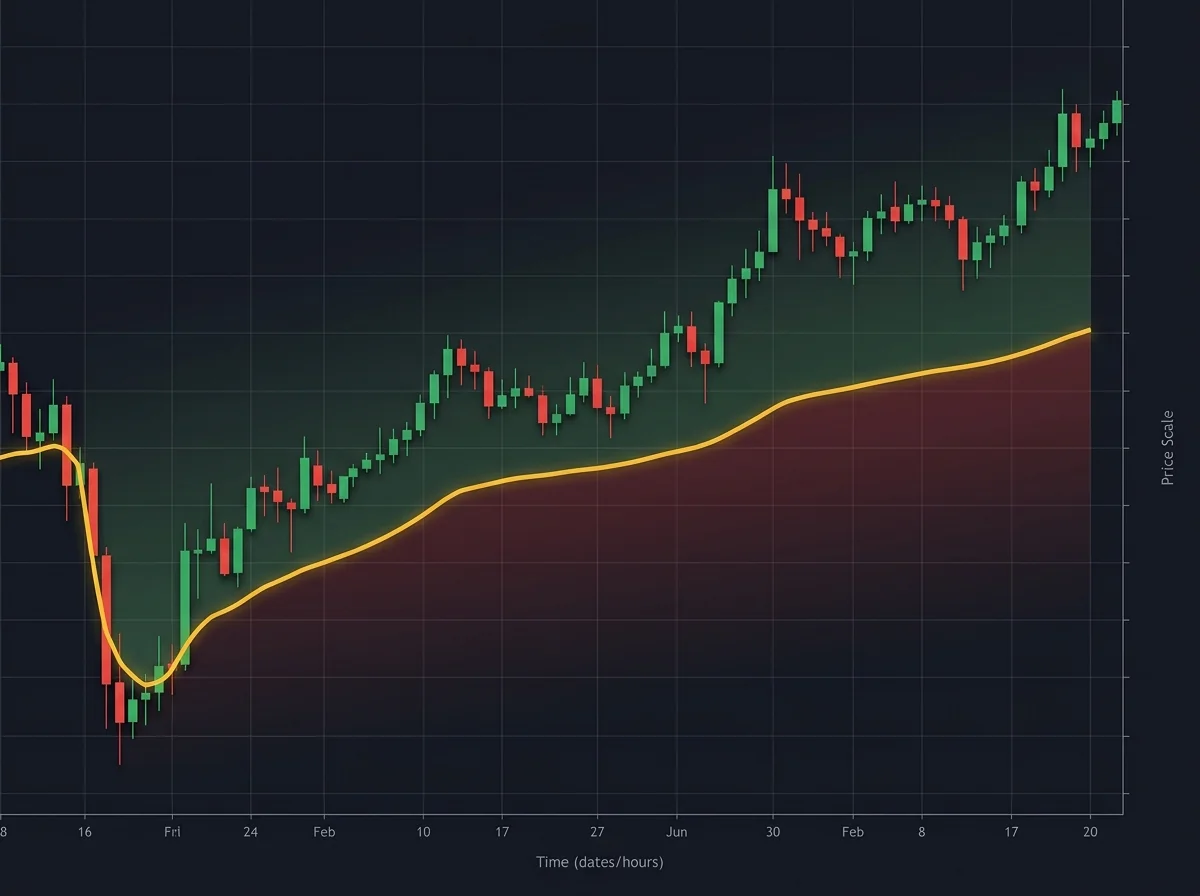
The weekly VWAP as a dynamic S/R level differs from a fixed horizontal line in an important way: it moves. As the week progresses and more price action develops, the VWAP level shifts based on where and how much volume has traded. This means the pullback entry level is not a fixed price target — you're watching for price to approach a continuously updating fair value reference.
Step-by-Step: Trading the Weekly VWAP Pullback
Step 1: Mark the Weekly Anchor at Monday Open
At the start of each trading week, place your VWAP anchor at Monday's opening candle. This creates your weekly fair value reference that will run until Friday's close.
Step 2: Assess the Week's Directional Bias
As the first several hours of the week develop, observe whether price is trending above or below the weekly VWAP. The early direction often sets the week's dominant tone.
- Consistent price action above the VWAP with each pullback finding support at or near it → bullish week developing
- Consistent price action below the VWAP with each rally meeting resistance at or near it → bearish week developing
Step 3: Identify Pullback Opportunities
When the week's bias is established, monitor for pullbacks toward the weekly VWAP:
- Bullish week: Wait for price to decline toward the VWAP. Don't short the pullback — wait for it to reach the VWAP zone and look for long entry signals.
- Bearish week: Wait for price to rally toward the VWAP. Don't buy the rally — wait for it to reach the VWAP zone and look for short entry signals.
Step 4: Drop to a Lower Time Frame for Entry
When price approaches the weekly VWAP on your primary time frame (30-minute or 1-hour), drop to the 5-minute chart to monitor the interaction. Watch for:
- Momentum slowing as price reaches the VWAP
- Candle wicks forming and reversing at the VWAP level
- A reversal candle forming at or very near the VWAP
Step 5: Enter, Stop, Target
Enter in the direction of the week's bias as price shows the reversal signal at the VWAP:
- Long entry (bullish week): Enter long. Stop below the VWAP with a buffer.
- Short entry (bearish week): Enter short. Stop above the VWAP with a buffer.
Target the most recent swing high (for longs) or swing low (for shorts) established earlier in the week.
When Does Weekly VWAP Work Best?
The weekly VWAP is most effective during clearly trending weeks — weeks where one directional move dominates from Monday through to the end of the week, with orderly pullbacks.
Ideal conditions:
- Price establishes a directional move in the first half of Monday
- Pullbacks toward the VWAP are shallow and orderly (no violent reversals through the line)
- News and macro events are not producing hourly direction changes
- The broader weekly trend is aligned with the daily trend
Strong weeks tend to follow major macro events that resolved cleanly (e.g., a central bank meeting that produced a clear outcome) or weeks following a breakout from a prior range.
When Weekly VWAP Becomes Unreliable
The weekly VWAP loses its predictive value in choppy, directionless, or volatile weeks:
- News-heavy weeks where major scheduled events (central bank decisions, major data releases) occur mid-week, causing direction changes mid-session
- Options expiration weeks where institutional hedging flows create unusual intraweek volatility
- Low-liquidity holiday weeks where reduced participation produces irregular price action
- Range-bound weeks where price oscillates back and forth through the VWAP without establishing a directional bias
In these conditions, the weekly VWAP may be crossed multiple times per day without clear bias. The setup frequency looks high, but the quality is low. The practical response: reduce trading activity and wait for a cleaner weekly structure before deploying the strategy.
Combining Weekly VWAP with Other Tools
The weekly VWAP gains additional precision when combined with complementary analysis:
Volume Profile: If the weekly VWAP aligns with a significant Volume Profile level — a point of control, value area edge, or high-volume node from a recent period — the confluence creates a stronger support/resistance zone than either tool alone.
Swing-anchored VWAP: Having both a swing-point-anchored VWAP and the weekly VWAP visible simultaneously creates powerful convergence zones. When both lines cluster at the same price level, that level has double confirmation as a fair value reference.
Daily bias: The weekly VWAP provides weekly context. The daily VWAP provides daily context. When both align (e.g., price above both the weekly and daily VWAP), the bullish bias is stronger than if only one alignment exists.
Key S/R levels: Fixed horizontal support and resistance zones that coincide with the weekly VWAP's current location are the highest-priority pullback entries in the strategy.
Time of Day and Session Timing
Weekly VWAP pullback setups are most reliable during high-liquidity market hours:
- Futures markets: The main US session (9:30 AM - 4:00 PM ET) and the period around the London-New York overlap (8:00 AM - 12:00 PM ET) for currencies
- Forex: The London session and the overlap with New York offer the clearest setups
- Avoid: Very early Asian session hours for non-Asian pairs, Friday afternoon when liquidity thins, and the immediate period around major news events
The weekly VWAP pullback works best during normal market hours with institutional participation active. The low-volume hours before major sessions can produce misleading touches of the VWAP line that don't result in meaningful reactions.
Common Mistakes to Avoid
Trading the weekly VWAP in a choppy week. As discussed, the strategy requires a trending week. Trading every VWAP touch in a range-bound week produces repeated whipsaws. Monitor the week's character first.
Ignoring the direction of the weekly bias. The weekly VWAP is a directional tool. Buying when price is below the VWAP (bearish context) or shorting when price is above it (bullish context) contradicts the strategy's fundamental logic.
Using a fixed take profit rather than targeting structure. The weekly VWAP doesn't tell you where price will stop. Use the week's developing swing structure for targets, not arbitrary pip distances.
Not accounting for the VWAP's dynamic nature. The VWAP level shifts as new volume trades at different prices. Check the current VWAP level before each session, not just once at the week's start.
Carrying the same anchor into the following week. The weekly VWAP resets each Monday. Remove the previous week's anchor and place a fresh one at the new Monday open. Carrying old anchors forward clutters your chart with outdated reference lines.
Final Thoughts
The weekly anchored VWAP is one of the simplest yet most structurally sound tools available to intraday and short-term swing traders. By grounding your analysis in a consistent weekly reference — one that reflects the full week's volume-weighted activity rather than resetting arbitrarily every 24 hours — you gain a directional bias filter that aligns your trades with the week's dominant institutional flow.
The pullback setup it enables is clean and logical: identify the week's bias, wait for price to pull back to the weekly VWAP, and enter in the dominant direction. The risk is defined (stop beyond the VWAP), the direction is clear (the week's bias), and the entry is precise (at the fair value reference).
Its limitations are real — choppy weeks diminish its value significantly, and no weekly anchor can withstand a mid-week macro shock that genuinely reverses the week's direction. Use it with awareness of these conditions, combine it with Volume Profile and swing-point VWAP analysis for confirmation, and reserve it for the clearly trending weeks where its edge is sharpest.
FAQ
Where exactly should I anchor the weekly VWAP?
At the first candle of Monday's trading session — typically Monday's opening candle. For 24-hour markets like forex, use Sunday's opening candle (the start of the institutional week) or Monday's open depending on your broker's market hours.
What does it mean when price is above the weekly VWAP?
It means the volume-weighted average price for the week is below the current market price. The week's dominant participation has been bullish. This creates a bullish bias — prefer long trades on pullbacks to the VWAP.
How many pullback trades can I take from the weekly VWAP in one week?
Typically 1-3 in a clearly trending week. In very strong trend weeks, the VWAP may only be tested once or twice before the week ends. Don't force entries — only trade the cleanest tests.
Should I use the weekly VWAP in all market conditions?
No. The weekly VWAP provides the clearest edge in trending weeks. In choppy or news-heavy weeks where price crosses the VWAP repeatedly, significantly reduce or eliminate trading from this setup.
Does the weekly VWAP work in futures markets?
Yes — and this is where it works best, given the precise volume data available in futures. It also works in forex using tick volume as a proxy, with slightly reduced precision.
How does the weekly VWAP differ from the daily VWAP?
The daily VWAP resets every 24 hours, capturing only intraday fair value. The weekly VWAP runs for the entire 5-day trading week from Monday open, capturing the full week's volume-weighted activity and providing a broader directional context.
Disclaimer: Educational content for traders. Not financial advice, not a signal service, and no outcome is guaranteed. Test every rule yourself before risking capital.
Comments (0)
Comments are moderated. Your comment will appear after it's approved.
Comments are moderated. Your comment will appear after it's approved.
Loading comments…