
Interpretive research — not trading advice
Trigger Mechanics: Entry & Risk Management (Scalping Mode)
Bonus page: how to trigger entries on a VAH or VAL break on the 30-minute frame, and how to manage stop and reward/risk on imbalance days — a companion to the five scenarios above.
Theoretical foundation: Auction Market Theory (AMT)
The market is a continuous auction between buyers and sellers, always searching for "Fair Value." From this principle come the concepts of Balance, Imbalance, the Value Area, and the Point of Control (POC) — this page defines the execution trigger specifically for imbalance scenarios.
Beginner-friendly explanation
Once the day's scenario is identified (say, Open Drive or Open Test Drive), the question becomes: exactly when do I enter? The answer here is the "trigger": entry happens the moment price breaks the VAH (upper value edge) or VAL (lower value edge) on the 30-minute frame, depending on the day's direction. On imbalance days specifically, there's no fixed profit target — price is trailed until clear absorption signals show the drive is exhausting itself.
بالعربية: بعد تحديد سيناريو اليوم، الدخول يتم فور اختراق مستوى VAH أو VAL على فريم 30 دقيقة حسب الاتجاه. في أيام الاختلال، لا يوجد هدف ربح ثابت — يُطارَد السعر حتى تظهر إشارات امتصاص واضحة تدل على استنفاد الاندفاع.
Trigger, continuation, and risk management
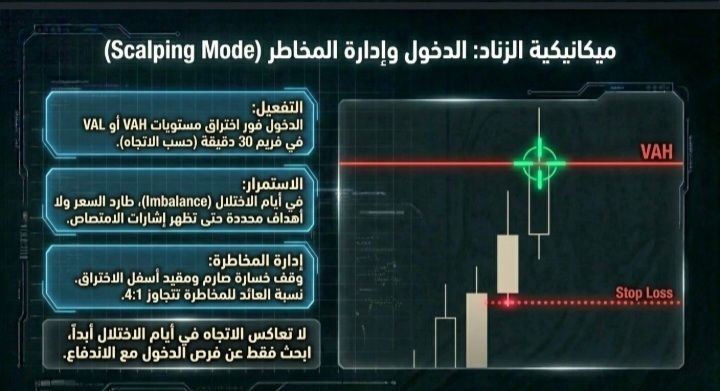
Entry the moment price breaks VAH or VAL on the 30-minute frame (per direction).
On imbalance days, trail price with no fixed target until absorption signals appear.
A strict, useful stop loss below the break, with a reward/risk ratio of at least 4:1.
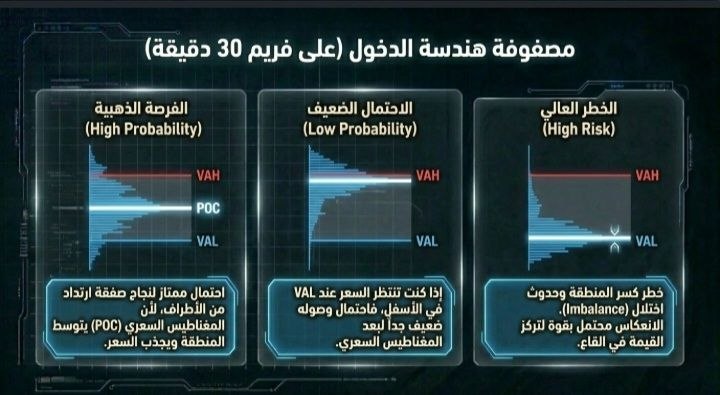
Final tactical decision
Never fade the direction on imbalance days.
Only look for entries with the drive, on an actual VAH/VAL break, with a reward/risk ratio of at least 4:1.
One learning reference
Risk warning
Price Bias Map: 5 Opening Scenarios That Shape the Day